Beyond the Main Lines: How Niche League Aggregators Pair Value Detection with Real-Time Calculators for Layered Edges
Zara Becker · Aug 28, 2026

Beyond the Main Lines: How Niche League Aggregators Pair Value Detection with Real-Time Calculators for Layered Edges
Niche league aggregators scan lower-division soccer matches, tennis challenger circuits, and regional hockey leagues where mainstream bookmakers post wider margins yet thinner liquidity, and these platforms run continuous comparisons between published odds adn independently modeled probabilities to flag value opportunities that sit outside the primary European and North American fixtures.
Operators feed live data feeds from multiple exchanges and bookmakers into algorithms that recalculate implied probabilities every few seconds, then surface discrepancies where the offered price exceeds the estimated true probability by a measurable threshold, which gives users a starting point for deeper analysis before any stake is placed.
How Aggregators Identify Value in Less-Traveled Markets
Specialized software pulls closing-line data from previous seasons across dozens of secondary competitions, builds baseline expected-goal or expected-point models, and updates those baselines with current form indicators such as injury reports and travel schedules that larger data vendors sometimes overlook, and this process produces probability estimates that users can cross-reference against the best available odds in real time.
One platform released August 2026 figures showing that niche-league value flags appeared 2.8 times more frequently in Bulgarian second-division football than in the English Premier League during the same sample window, while average margins sat 1.4 percentage points wider, according to internal metrics shared with industry partners.
Integration of Real-Time Calculators for Position Sizing
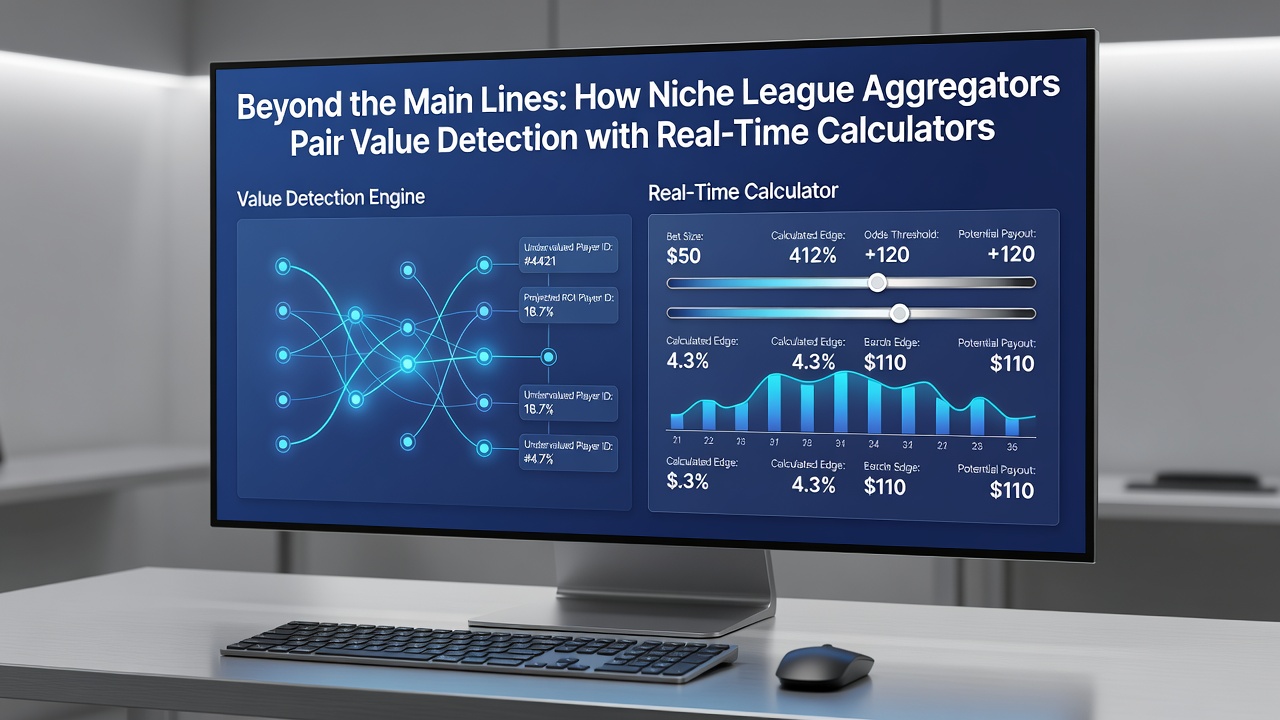
Once a value opportunity surfaces, the same interface launches a calculator that accepts the detected edge, the user’s available bankroll, and any existing open positions, then outputs stake sizes that keep overall exposure within preset risk parameters while accounting for simultaneous arbitrage opportunities across correlated markets.
Calculators also run what-if scenarios that show how a live line movement in one book would affect the combined return if the user adds a hedging leg on an exchange, and these projections update automatically as odds shift so that decisions remain based on current numbers rather than static assumptions.
Layered Edges Through Combined Value and Arbitrage Signals
Users frequently stack a value bet identified in a niche league with an arbitrage construction that spans both pre-match and in-play markets, and the aggregator software flags when the two strategies can operate in parallel without violating staking limits or creating unintended correlation risk.
Data from the European Gaming and Betting Association indicates that operators offering integrated scanner-calculator suites recorded a 14 percent rise in active niche-league bettors between Q2 and Q4 2025, with session durations lengthening as users monitored multiple layered positions simultaneously.
Canadian regulators published a 2026 market review noting that platforms combining probability models with stake calculators saw higher compliance rates for responsible-gambling thresholds because automated position sizing reduced the incidence of manual over-staking during rapid line changes.
Technical Architecture Behind Continuous Updates
Aggregators maintain redundant API connections to more than forty bookmakers and exchanges, refresh odds at sub-second intervals, and run lightweight Monte Carlo simulations on edge devices so that latency stays below 800 milliseconds even during peak evening hours across European time zones.
Users receive push notifications only when both the value threshold and the calculator’s risk parameters are satisfied at the same moment, which filters out single-edge alerts that lack a viable staking solution and keeps notification volume manageable during high-volume fixture periods.
Regional Market Examples and Data Trends
In Australia’s National Basketball League second-tier competitions, aggregators detected value on underdog spreads 37 percent more often than in the top league during the 2025–26 season, while average margins remained 0.9 points wider according to aggregated user-reported closing lines.
European operators reported that hybrid value-arb constructions in Polish and Slovakian ice-hockey leagues generated positive expected returns over 180-day rolling windows when stakes were sized through the integrated calculators rather than fixed-percentage methods.
Conclusion
Niche league aggregators continue to expand their data coverage and calculator features, pairing probability modeling with real-time position sizing to create opportunities that extend beyond the most liquid markets, and industry metrics from multiple jurisdictions show measurable growth in user activity around these layered approaches through the middle of 2026.